By Omar Vázquez Heredia
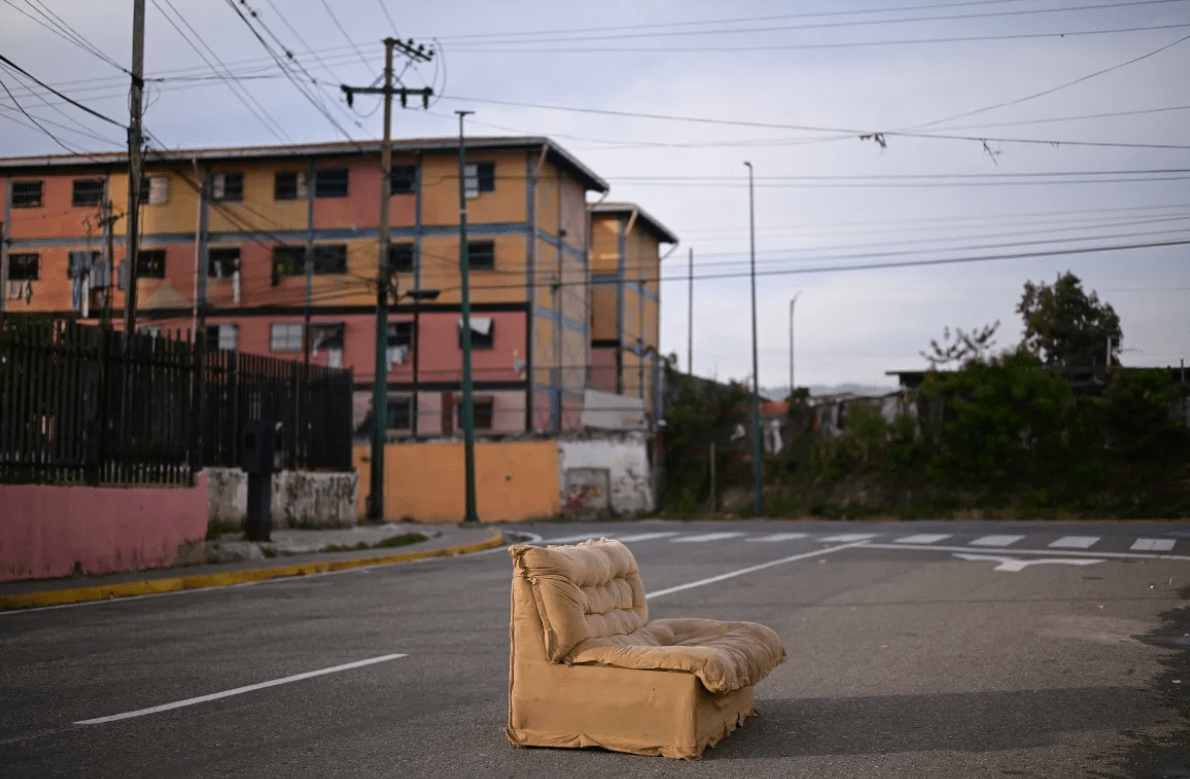
Picture: Gaby Oraa
The US operation in Venezuela seems to have taken everyone by surprise: those who thought it would never happen and those who believed that Nicolás Maduro’s “removal” would pave the way for María Corina Machado to take office in Miraflores Palace. Now a complex process is beginning, with former Vice President Delcy Rodríguez in charge of a power structure overseen by Trump himself, who boasts of being the one who “rules” the country.
The US military action, which involved bombing different areas of central Venezuela and capturing President Nicolás Maduro, has been met with perplexity and in survival mode by the Venezuelan population. The day after the invasion of the national territory, there was a peculiar calm. Vice President Delcy Rodríguez took power, there was no military presence in the streets—and the presence of police and paramilitary groups was scarce—and Donald Trump and Marco Rubio sidelined María Corina Machado for the transition: “I think it would be very difficult for her to be the leader. She does not have the support or respect of the country.” This was a seemingly surprising reaction for a president who had recognized Edmundo González, Machado’s candidate, as the winner of the 2024 presidential elections.
A sector of the Venezuelan population is bewildered because many had ruled out the possibility of a US military operation on Venezuelan territory after five months of verbal threats from Trump, in the context of a huge US naval deployment in the Caribbean, near the coast of Venezuela. Another sector is disconcerted because it believed that the capture of Nicolás Maduro in a “surgical” armed operation would mean the fall of the entire Bolivarian regime and the immediate beginning of a “democratic transition” under the leadership of María Corina Machado and a government led by Edmundo González.
The Venezuelan population, accustomed to shortages and hyperinflation, immediately rushed to stock up at supermarkets, pharmacies, bakeries, and grocery stores. In these places, without any military or police presence, long lines of people were seen waiting quietly and calmly for their turn to make purchases with cash dollars or, where there was electricity, with debit cards.
But added to the current problems is now the uncertainty over the possibility that Trump will order a new military attack on Venezuelan territory to strike at the national government led by Delcy Rodríguez. In this regard, Venezuelans know that their democratic freedoms and rights remain suspended and restricted, and also that their access to basic goods, such as electricity, water, medicine, and food, will surely continue to be affected by US interference in the form of economic sanctions and, now, military operations.
The government of Delcy Rodríguez has attempted to demonstrate that it maintains a unified leadership: the Supreme Court of Justice ordered the vice president to assume the role of acting president, and she was subsequently sworn in before the new National Assembly. In this way, an attempt has been made to hide the prevailing perplexity following the capture of Nicolás Maduro—without any reaction from the Armed Forces—which is leading leaders to act on their survival instinct.
In her youth, Delcy Rodríguez was a member of the Socialist League, where she was a fellow activist with Nicolás Maduro. That Marxist-Leninist organization, which dissolved in 2007 into the United Socialist Party of Venezuela (PSUV), was founded by the new president’s father, Jorge Antonio Rodríguez. This former student leader at the Central University of Venezuela was assassinated in 1976, when he was tortured by police officers during the first government of Carlos Andrés Pérez (1973-1979). Delcy Rodríguez assumed important responsibilities in Hugo Chávez’s government, such as the Ministry of the Presidency. But she only lasted six months and left office amid tensions with the then president. However, when Nicolás Maduro took over the leadership of Chavismo in 2013, following the death of Hugo Chávez, Delcy Rodríguez rose to top positions, including the Vice Presidency of the Republic, the Foreign Ministry, and the strategic Ministry of Petroleum and Mining. She always worked in tandem with her brother, the equally powerful Jorge Rodríguez, another high-ranking official in Maduro’s administration, which is why many refer to them as “the Rodríguez.”
Now, the official narrative to justify Delcy Rodríguez’s appointment as acting president appeals to Article 234 of the National Constitution, which establishes the mechanisms for replacing the president in the event of temporary absence. At first, the former vice president reiterated her loyalty to Maduro upon assuming her new position and demanded his release and return to Venezuela. However, there is a persistent rumor—impossible to confirm or refute at this time—that there was an agreement with the United States to carry out a post-Maduro transition, promoted in alleged negotiations held in Qatar.
This would not be the first time that rumors have circulated about disloyalty to Maduro, highlighting the alleged secret efforts of “the Rodríguez” to promote an orderly and negotiated political transition. In 2024, there was speculation that Jorge Rodríguez, recently re-elected president of the National Assembly, had been responsible for overestimating electoral support for the ruling party and had recommended allowing Edmundo González to participate in the presidential election on July 28 of that year, instead of blocking the registration of any candidate supported by María Corina Machado, who herself had been banned. Furthermore, as former president of the National Electoral Council, Jorge Rodríguez also failed to warn of the need to withhold election records from opposition polling station observers, which served as evidence of an unfavorable result for the government. In the absence of information, various speculations from Venezuelan and foreign analysts are now filling the pages of newspapers.
Meanwhile, the interim government has ratified its military and police control of Venezuelan territory, its main asset in any negotiations with Donald Trump and also the factor that seems to have led to the US’s refusal to recognize Machado’s political legitimacy.
Dialogue between the Trump and Delcy Rodríguez administrations is already underway, and the first signs of this could be the continuation of Venezuelan oil exports to the US market by Chevron and the flights of Venezuelan migrants deported by the US to Venezuela. Trump announced that the new leader will pay a high price “if she doesn’t do the right thing” and, in line with his appearance after Maduro’s kidnapping—and his willingness to write his own “corollary” to the Monroe Doctrine—he confirmed that he wants “total access to everything” in Venezuela. In an interview, the New York tycoon announced that he is the one “running” the country. A group of four senior officials whom he trusts most will help oversee this “management“: Secretary of State Marco Rubio, the ideologue behind the policy of maximum pressure and the overthrow of Maduro; Pentagon chief Pete Hegseth; his deputy chief of staff and domestic policy advisor Stephen Miller; and Vice President J.D. Vance. Trump also confirmed that there will be no elections in Venezuela in the next 30 days. The US president wants all the limelight, without any competitors.
In this context, the Delcy Rodríguez government’s military and police control of Venezuelan territory appears fragile for several reasons: the capture of Nicolás Maduro without an armed response commensurate with the defensive capabilities of the Bolivarian National Armed Forces (FANB) revealed the limitations of armed forces in which the government has invested huge sums of money; FANB military personnel were still in their barracks two days after the US military attack; since the July 2024 presidential election and under the command of Diosdado Cabello, there has been an increase in the size and firepower of military and police components parallel to the FANB, such as the General Directorate of Military Counterintelligence (DGCIM) and the Bolivarian National Intelligence Service (Sebin). Finally, it is unlikely that the political preferences of FANB officers and troops were not reflected in the July 2024 election, in which the main opposition candidate obtained, according to the published results, around 70% of the votes.
In a surprisingly calm “day after,” the government of Delcy Rodríguez is already making efforts to gradually restore normal public services, transportation, and commercial activities in the residential areas most affected by the military attack. This seems to indicate that the main objective of the government’s actions is to demonstrate its ability to govern Venezuela. This is the card that allows it to present itself as the indispensable partner for maintaining public order in the country and enabling US access to Venezuelan oil—Trump’s obsession—in a context of declining Venezuelan oil infrastructure.
Finally, the various factions of the opposition, both inside and outside Venezuela, hold a variety of positions: the traditional sector led by María Corina Machado celebrated the US military action and the capture of Nicolás Maduro, but remains silent on the disregard for its leadership and Trump’s statement in which he assumed the role of de facto colonial administrator of Venezuela. This is particularly tough for a leader who has been calling for military action by Washington for years and who, after its successful completion, declared herself ready to “take power.” The moderate traditional opposition sector also does not directly question the US military action, but demands the restoration of democracy in the country. Finally, the left-wing opposition and critical Chavismo interpret what has happened as an imperialist attack, while denying any support for Maduro and now Delcy Rodríguez.
Unfortunately, it seems that in the short term, Venezuela’s future will depend on Donald Trump’s armed threats and the ability of the acting president to obtain and maintain the support of the military and police apparatus. Thus, it seems that we are still far from the moment when the Venezuelan people, in the exercise of their sovereignty, can freely decide their future in national elections in which all political currents existing in Venezuelan society can participate on equal terms. Marco Rubio himself ruled out an election in the short term in the name of the need to resolve more urgent problems.
Consequently, the political scenarios for Venezuela seem to boil down to two. In the first, Delcy Rodríguez, or another Chavista leader if she is displaced, manages to consolidate a Madurismo without Maduro, in which the suspension and restriction of democratic freedoms and rights are maintained while, as Delcy Rodríguez herself had been doing from the economic vice presidency, the opening of the economy continues to benefit transnational and national capital. In this sense, beyond the current agreements between Petróleos de Venezuela (PDVSA) and Chevron, better conditions could also be created for this and other US oil companies, and the partnership with Chinese oil capital and the export of Venezuelan oil to China could be suspended.
In the second scenario, Delcy Rodríguez accepts or is forced to accept the progressive dismantling of Maduro’s regime, while maintaining the economic opening with benefits for US oil capital. In this way, the government could negotiate, in exchange for impunity, a general amnesty for all political prisoners, the return of the right-wing and left-wing opposition parties that have been judicially intervened to their legitimate national leaderships, and, finally, the calling of free elections for all elected positions.
The recent re-election of Jorge Rodríguez as president of the National Assembly for the year 2026 is another demonstration of the weight of the Rodríguez siblings in Maduro’s succession and within the Chavista government structure. In the event of her absence as president of the Republic, Delcy Rodríguez must be replaced by her brother.
The enactment of the State of External Commotion Decree, signed by Maduro last September but published after the US military intervention, also confirms the continuation of the suspension and restriction of democratic rights and freedoms, because Article 5 orders the search and capture of persons involved in promoting and supporting the US armed attack, an accusation that can be weaponized to persecute dissidents.
Today, leftist and progressive forces in Latin America, the United States, and Europe, in addition to condemning Donald Trump’s military action on Venezuelan territory, should also call for respect for human and democratic rights by the government of Delcy Rodríguez. Anti-imperialism becomes authoritarian if it is not accompanied by the demand for respect for fundamental rights and denies the possibility of dialogue with the vast majority of the Venezuelan population.
Originally published in Spanish by NUSO magazine.
 Venezuelan Voices