
By Oswaldo Pacheco
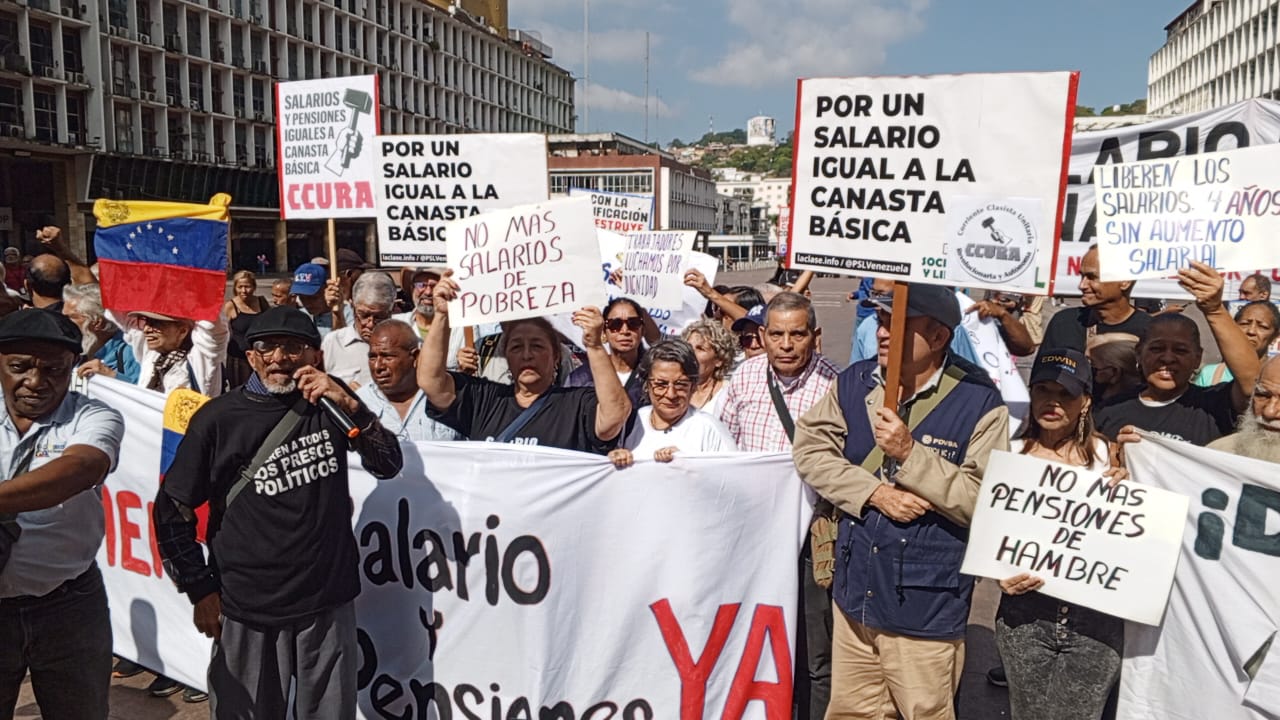
Photo: National workers’ protest in front of the Ministry of Labor, Caracas, February 26, 2026
Faced with imperialist aggression, the government’s capitulation, and the bosses’ offensive, the Venezuelan working class demands what belongs to it.
While Venezuela’s oil figures point to a significant recovery in revenues, the working class continues to wait for that wealth to translate into real purchasing power. The contrast could not be more striking: the oil sector projects 20% growth by 2026; oil revenues could exceed an additional $9 to $10 billion compared to 2025; Chevron produces between 290,000 and 300,000 barrels per day; and in just a month and a half, $800 million from crude oil sales entered the Venezuelan banking system. However, annualized inflation for the period January 2025–January 2026 stands at around 570%, destroying real wages.
From the Class Unitary, Revolutionary, and Autonomous Current (C-cura), we denounce the coordinated offensive that Venezuelan business leaders—with the active complicity of the national government—are waging against the rights of the working class, and we call for the organization of independent mobilization against it.
Bosses’ agenda
Jorge Roig, Fedecámaras (business association) representative to the ILO, proposes to make any wage increase conditional on the elimination of the retroactive calculation of severance payments*. The proposal is not new: in 1997, under Caldera, the same argument was used. That year, retroactivity was eliminated with the promise of better wages. Improved wages never came and retroactivity was indeed lost. Today, Roig is recycling that same script as if history did not exist.
What Roig is proposing specifically is an Emergency Labor Law that would allow bonuses to be paid outside of wages without impacting benefits, vacations, or seniority, and then discuss the substance of the matter. In other words: a nominal wage increase today in exchange for handing over the accumulated future wealth of workers.
José Bodas, secretary general of the United Federation of Oil Workers of Venezuela (Futpv) and leader of our union tendecy, described the proposal as immoral and warned that it is a strategy to obtain cheap labor, taking advantage of the imminent increase in oil revenues to the country. It could not be clearer.
Tito López, president of Conindustria, goes even further, demanding a comprehensive reform of the Organic Labor Law. His words leave no room for interpretation:
“The Labor Law must be revised, all articles corresponding to the social benefits regime, job security, rehiring, vacation regime, because if a wage increase is approved without reforming the law, it will undoubtedly break companies, because they will not have the capacity to assume these commitments.”
Translated into plain language: employers want economic recovery without income redistribution. They present wages as a threat to the economy, when in reality they are a threat to their profit margins. The argument of inability to pay falls apart in the face of the data: the industrial sector reports sustained recovery and projects growth for 2026. There is no inability, there is refusal to increase wages. It should also be remembered that Decree No. 5,070 —in Official Gazette No. 6,868 of December 27, 2024— guarantees job security until December 31, 2026. What Conindustria is asking for is to dismantle that decree before it expires, to wipe out decades of workers’ achievements by promising a wage increase that, as history has already shown, may never materialize.
It is worth noting the contradiction expressed by Conindustria: when defending its interests before the State, it demands preferential access to foreign currency, tax relief, and soft financing. But when it comes to recognizing the efforts of the workforce that sustains that industry, it puts forward the excuse of incapacity. The government, for its part, panders to the business community by granting resources for capital and decreeing scarcity for labor. This is capitalist class politics, not “responsible business management”, much less the defense of labor that the government often proclaims.
The government is complicit
It would be a mistake to believe that this offensive comes from outside and that the government is resisting it. By March 2026, the minimum wage will have been frozen for four years. The mechanism of non-contractual bonuses—exactly what Roig proposes to formalize into law—is already the de facto policy of the Venezuelan state: payments that do not count toward benefits, vacations, or seniority. Roig himself acknowledges that in 2022, 74% of workers’ income were wages, while today 96% is bonuses.
Collective agreements in education, health, and public companies have not been discussed for years. The ban on layoffs exists on paper but is flouted in practice without consequences. What we have is the convergence of a government that pays lip service to defending workers but in practice applies harsh capitalist austerity measures in agreement with the capitalists, whereby they agreed to substitute wages with bonuses, end collective bargaining, and eliminate freedom of association, destroying labor rights. This policy has been implemented through draconian instruments such as Memorandum 2792 and the ONAPRE (National Agency for Public Administration Reform) guidelines.
Imperialist aggression and capitulation: the background that cannot be ignored
To understand the full logic of this attack, it must be placed in context. Donald Trump’s far-right government launched one of the most aggressive imperialist offensives in the continent’s recent history against Venezuela: suffocating economic sanctions, financial blockade, persecution of the oil industry, the bombing of small boats in the Caribbean under false accusations of drug trafficking—resulting in more than 100 people killed— and the brutal aggression of January 3. All of this caused real and profound damage to the national economy and, with it, to the living standards of the working class.
However, the government’s response was not the sovereign resistance it had proclaimed for years. It was negotiated capitulation.
Instead of a people led way out that put workers at the center, the government chose to negotiate with Washington the terms of its own political survival: oil concessions, opening up to transnational corporations, migration agreements, and the acceleration of an economic drift that is increasingly aligned with the demands of imperialist capital. The working class is paying the price for this capitulation. Venezuela runs the risk of becoming, once again, the imperialist backyard: not by force of arms, but by the will of those who prefer to rule at any cost, handing over our resources and impoverishing the working class to favor national and transnational capitalists.
The labor movement and other exploited and oppressed sectors did not provoke this imperialist aggression, nor did they decide on the capitulation and surrender of the Chavista government. They have no reason to bear the costs. The working class has a historic obligation to fight to improve the living and working conditions of the Venezuelan people and to aspire to a government of the workers, who are the only ones who produce wealth.
The opposition led by the bosses is not the solution either
We warn with equal clarity: the opposition bloc led by María Corina Machado, Edmundo González Urrutia, and Leopoldo López, among others, does not represent the interests of workers either. Their program—privatization of PDVSA, unrestricted opening to transnational capital, labor flexibility under IMF guidelines—is radically incompatible with the interests of those who live on a salary. They were enthusiastic spokespeople for the international sanctions that devastated state financing and, with it, the wages of public workers and social services. Those who promoted this blockade cannot today present themselves as allies of the people who suffered from it. The opposition of the capitalist bosses has its own class interests. They are not ours.
Unity, mobilization, and class independence
Resources are coming into the country from oil sales, but no one is going to give anything away. For this to translate into benefits for the people and workers, we need to organize and fight for our main demands. We must demand that these resources be allocated to wages, pensions, health, education, and public services. In this context, we demand 100% state-owned oil industry, without joint ventures or transnational companies; progressive taxes for all transnational companies and large national companies; and that all this money, in addition to the revenue from oil sales, go to the sovereign funds proposed by the government for wage increases, health, education, and food and medicine production.
An amnesty law has just been passed in the National Assembly, which should provide full freedom to all prisoners, as well as guarantees of non-repetition and reparation. In this regard, we propose that all detained workers should be reinstated to their jobs, with back pay; the right to strike should be restored and freedom of association respected; the persecution of union leaders should cease and they should be given guarantees that they will be able to exercise their functions of representing workers without any restrictions.
Repression and persecution must cease, and all repressive measures and laws must be abolished, such as the External Commotion Decree; the Constitutional Law against Hate, for Peaceful Coexistence and Tolerance; the Organic Law on Food Security and Sovereignty; the Law against Terrorism and Organized Crime; and the “Simón Bolívar” Law.
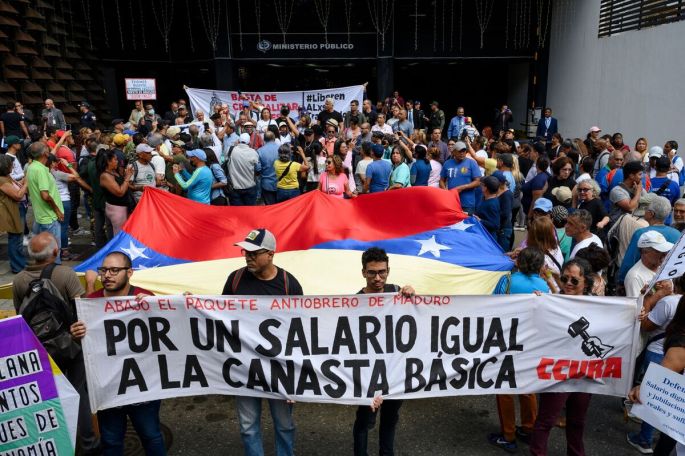
The objective conditions for the struggle are in place. What is missing is consistent leadership. The C-cura trade union movement calls on trade union confederations, federations, grassroots unions, and workers’ movements to take the lead with a concrete mobilization plan: assemblies in factories, hospitals, schools, universities, and public companies; unified days of protest; delegations to the Labor Inspectorates; and a national agenda for struggle with a central and non-negotiable demand: wages and pensions equal to the basic basket of goods, now. Without touching the retroactivity of benefits. Without giving up job security. Without renouncing re-employment.
This mobilization must be sustained from a position of class independence. The labor movement cannot subordinate its struggles to the designs of Yankee imperialism, nor to the timing of the government, nor to the strategies of Fedecámaras and Conindustria, nor to the electoral calendars of the opposition.
The strength of workers lies in their autonomous organization and mobilization and in class solidarity. Every time that autonomy was surrendered—to a capitalist party, a government, a faction of employers—the workers lost. We will not make that mistake again.
Oil flows. Dollars come in. Profits recover. Only wages and pensions remain unchanged. This is not economic fate: it is a political decision that can and must be reversed through organization, struggle, and class independence. We propose all this within the strategic perspective of fighting for a working class and people’s government.
Oswaldo Pacheco is a member of C-cura.
Translator’s note:
*Because of historically high inflation, severance payments in Venezuela were calculated on the basis of the wage earned at the moment when the labor relation ended and retroactively applied to the amount of years the labor relation lasted. Between 1974 and 1997 this payment was equivalent to 60 days per year of work if the layoff was unjustified, and 30 days in case of a legally justified layoff. In 1997, as part of a labor counter-reform, the retroactive calculation was eliminated, drastically reducing severance payments for workers. Chavismo reinstated this mechanism in 2012, albeit with a payment of 30 days per year.
 Venezuelan Voices