
By Simón Rodríguez
Originally published by NACLA in English and Spanish
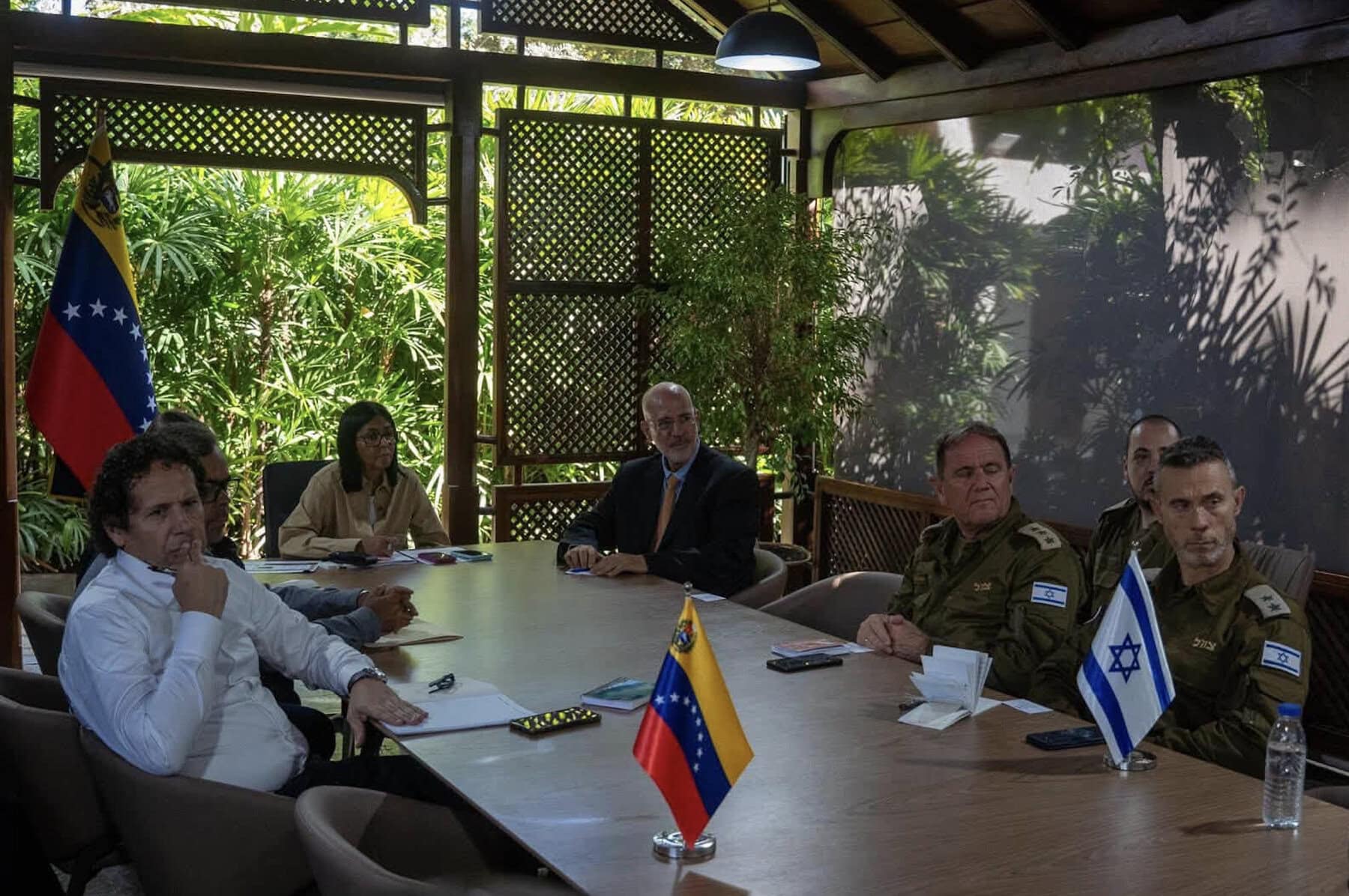
On July 22, nearly one month after twin earthquakes rocked northern Venezuela, a contingent of Israel Defense Forces (IDF) officers, members of Israeli nongovernmental organizations, and diplomatic personnel—some thirty people in total—completed an aid mission to the country. They had been sent in the wake of the earthquakes that have so far claimed more than 6,100 lives and left thousands more missing. Their mission earned them public praise from Israeli Prime Minister Benjamin Netanyahu and Venezuela’s de facto president, Delcy Rodríguez.
The mission was portrayed by both governments as aiding the restoration of diplomatic relations, severed since 2009. It also clearly served to generate humanitarian propaganda for the Israeli state, which faces growing international condemnation and legal proceedings before the International Court of Justice and the International Criminal Court (ICC) for genocide and war crimes against the Palestinian people. This push to re-establish diplomatic ties, however, is not unprecedented under Chavista leadership, whose relation with Israel has been more contradictory than is widely discussed. At the same time, this normalization process must also be contextualized against the backdrop of the post-U.S. invasion alignment of the new government with the policy goals of the Trump administration.
A Long History of Humanitarian Aid Washing
The IDF, Israeli NGOs, and Israeli companies have a long history of seeking to gain international legitimacy in the region through the provision of humanitarian aid during times of emergency. The IDF and the Israeli Forum for International Aid (IsrAID) have deployed in the wake of numerous earthquakes in Mexico and Haiti, Brazil’s deadly 2019 dam collapse, and other natural disasters.
Now, against the backdrop of a genocide, the PR strategy has gone into hyperdrive.
Among the NGOs involved in the mission, ZAKA stands out. Founded in the 1990s by Yehuda Meshi-Zahav, a former member of the ultra-Orthodox terrorist organization Keshet, ZAKA has being mired in scandals involving corruption, abuse, and its lies in the service of official propaganda, as the source of widely refuted fabrications regarding beheadings of infants, mass rapes, and the use of ovens during the military actions by Palestinian resistance factions on October 7, 2023—propaganda that served Israel’s ongoing scorched-earth campaign in Gaza.
A ZAKA delegation arrived in Venezuela on June 29. Its director for Latin America, Yosef Garmon, had previously published a video of himself speaking in Spanish amidst the rubble in Gaza, appealing to Christian Zionists for their support and defending Israel’s wars of aggression as beneficial to persecuted Christians. In Caracas, Garmon delivered a religious speech about “the chosen people” at the Central University of Venezuela, where right-wing student organizations had set up a tent flying the Israeli flag.
Garmon told the Israeli press that an earthquake survivor asked him to perform religious rites over his mother’s body and that the same man described the Israeli mission as the one that brought “the most light and hope,” despite providing fewer personnel and less equipment than those from other countries.
Israeli companies have also taken advantage of the situation to engage in image-cleansing operations. Such is the case with XTEND, whose drones deployed in La Guaira in July; the same company’s drones have been used extensively in the military campaign in Gaza.
“Rebuilding Ruins and Relations”
From the beginning, the aid mission has been framed as a step towards reestablishing relationships between the two countries.
Though Venezuelan state media and the Israeli press reported that the Israeli delegation focused on assessing the damage to infrastructure, diplomatic and public relations efforts took center stage. “Regarding the countries with which we do not have diplomatic relations (…) I hope this (aid) will open new paths and doors, as I have told many of the leaders with whom we do not have diplomatic relations,” Delcy Rodríguez reaffirmed at a press conference on July 2. Members of the Israeli delegation credited current foreign minister Félix Plascencia with assuring them that diplomatic relations would indeed be restored.
In a video call on July 9 with the head of the Israeli delegation, Brigadier General Elad Edri, of the IDF Home Front Command, and the ambassador-designate to Mexico, Yoed Magen, Netanyahu praised the achievements of the mission that arrived in Venezuela on July 1st. “You are rebuilding ruins and relations. You are showing the people of Venezuela, and also the government, the true face of the State of Israel (…) you are proving how good it is to have relations with Israel,” said Netanyahu, emphasizing the importance of the “diplomatic front” and “the human connection between nations.”
Israeli media reported that, at the request of the Venezuelan government, Israeli military personnel extended their presence in the country and prepared a national reconstruction plan.
Chavismo’s Complicated Relationship With Israel
While the Venezuelan right’s relation with Israel has been straightforward, as Maria Corina Machado’s party signed a cooperation agreement with Netanyahu’s Likud party in 2020 and has promised to open a Venezuelan embassy in occupied Jerusalem if she takes power, Chavismo has a more complicated relation with Israel. Diplomatic relations have been severed since January 2009, when then-President Chávez condemned “Operation Cast Lead,” which Israel launched against Gaza, killing more than 1,400 Palestinians. Chávez closed the Israeli embassy in Caracas, expelled its diplomats, and three months later recognized the Palestinian National Authority.
Under former President Nicolás Maduro, the relationship was more pragmatic than it appeared.
In 2021, officials from the General Directorate of Military Counterintelligence boasted about the acquisition of UFED cell phone espionage equipment, supplied by the Israeli company Cellebrite. Key members of the state, too, had business ties with capitalists from the Israeli-Venezuelan community. As early as 2011, an internal U.S. State Department cable published by Wikileaks identified Isaac Sultán Cohen as an alleged front man for Diosdado Cabello, at the time Minister of Public Works and Housing and currently Minister of the Interior, Justice and Peace. The Binian business group—whose board includes individuals who have also held leading roles in the Israeli Association of Venezuela (AIV)—has also reportedly been associated with government-linked businessmen in major infrastructure projects in Caracas.
Isaac Cohen, chief rabbi of the AIV, was decorated by Maduro in 2018. Recently, he was specifically thanked by interim leader Delcy Rodríguez for his mediation with the Netanyahu government, which resulted in the deployment of the Israeli mission following the earthquakes. The two had crossed paths before; in 2017, Cohen declared publicly that Rodríguez, then Foreign Minister, had told him of her aim to “establish full relations with the State of Israel.”
A few days after the attack on January 3, Nicolás Maduro Guerra called for the restoration of diplomatic relations with Israel. Maduro Guerra, son of the former president and a member of the National Assembly, is also vice president for Religious Affairs of the United Socialist Party of Venezuela and has developed ties with Protestant churches that advocate Christian Zionism.
The Wider Subordination to U.S. Policy
These overtures by the Venezuelan government were interspersed with criticism, especially after the start of the Israeli genocidal campaign in Gaza in 2023. Crucially, the latest intensified rapprochement comes against the backdrop of wider re-alignment with the U.S. and its foreign policy.
Delcy Rodríguez assumed the presidency of Venezuela in the wake of the U.S. attack of January 3, in which invading forces killed 81 people and kidnapped Maduro and his wife, Cilia Flores. While Rodríguez stated that the operation had a “Zionist undertone” in her first public address following the attack, she quickly changed her tune.
In the weeks that followed, the Venezuelan government reestablished diplomatic relations with the U.S.—severed since 2019— and received visits from several high-level officials, including CIA Director John Ratcliffe, the head of U.S. Southern Command Francis Donovan, and Secretary of Energy Chris Wright. As a product of these visits, and at the request of the Trump administration, the country’s hydrocarbons and mining laws were rapidly reformed without public discussion to better suit the interests of U.S. companies. Venezuela even ceded to the U.S. the marketing of its oil exports, which have generated approximately $13 billion this year.
In recent months, Delcy Rodríguez even authorized a U.S. air force exercise in Caracas and a U.S. airstrike on Venezuelan territory against an alleged gang leader.
This subservience to the policy goals of the Trump administration is also evident when it comes to foreign policy. Oil shipments to Cuba, long a lifeline for the island, ceased and, for the first time since mid-2020, Venezuelan oil was shipped to Israel. The new government has also all but abandoned its anti-imperialist rhetoric. When the U.S. and Israel attacked Iran in February, government representatives at first responded with a vague statement regretting that a “military route” had been taken, though they deleted their critique shortly after. Rodríguez also critiqued Iran’s response, a long-time ally, and expressed her solidarity with Qatar, where a U.S. base was targeted.
The Venezuelan government even joined the U.S. campaign against the ICC, announcing its decision to withdraw from the Rome Statute on July 24 of this year. This campaign was initiated in response to the ICC’s arrest warrants for Netanyahu and former Defense Minister Yoav Gallant in November 2024, for war crimes in Gaza—including the use of starvation as a method of warfare and intentional attacks against the civilian population, among other offenses. The U.S. government escalated its threats against the ICC and called on other governments to withdraw from it. Though Delcy Rodríguez defended the withdrawal on the grounds of a disproportionate targeting of African and Latin American countries by the ICC, its timing was eloquent and the State Department applauded the “Venezuelan government’s partnership on American-led efforts to dismantle the corrupt and worthless ICC.”
Grassroots Pushback
The warming of relations between the two countries, and Israel’s ostentatious military presence in Venezuela has been met with outrage from social movements and Palestinian solidarity activists.
Palestinian-Venezuelan journalist Dima Khatib, drew attention to the track record of some delegates, such as the Uruguayan-Israeli military officer Roni Kaplan, the IDF’s spokesperson for Spanish-speaking countries. On May 29, he was criminally charged in Uruguay by social organizations that requested an investigation for war crimes, crimes against humanity, and genocide.
Venezuelan left-wing opposition organizations, grouped under the National Forum in Defense of the People’s Rights, also criticized the Israeli presence in a statement. They noted that their roles, like those of the U.S. military, went beyond the immediate response to the disaster. The Socialism and Freedom Party declared that “a state that attacks those who save lives in Palestine and carries out genocide against the Palestinian people cannot present itself as a savior in Venezuela.”
Many of these attacks, as critics noted, have targeted humanitarian workers specifically. According to figures published by the UN Office for the Coordination of Humanitarian Affairs, between October 2023 and July 2026, the Israeli military killed 595 Palestinian humanitarian workers, 145 Civil Defense members during rescue efforts, and more than 1,700 healthcare workers in Gaza. In one of the most shocking massacres, the IDF killed fifteen Palestinian humanitarian workers on March 23, 2025, in Tel al-Sultan.
On July 25, dissident Chavistas protested in Caracas’s Plaza Bolívar against U.S. and Israeli military presence. Military spokesperson Kaplan addressed this type of criticism, describing it as the rhetoric of “far-left extremists (…) who employ the narrative of jihadist-style Islamic radicalism.”
The path of subordination charted by Rodríguez will be difficult to alter: it is the crux of her strategy for staying in power. Thus, amid the ruins of La Guaira, which inevitably remind us of the ruins of Gaza, a new relationship appears to be emerging between the puppet government of Delcy Rodríguez and Netanyahu’s genocidal regime.

