By Omar Vázquez Heredia
Photograph: Matias Delacroix
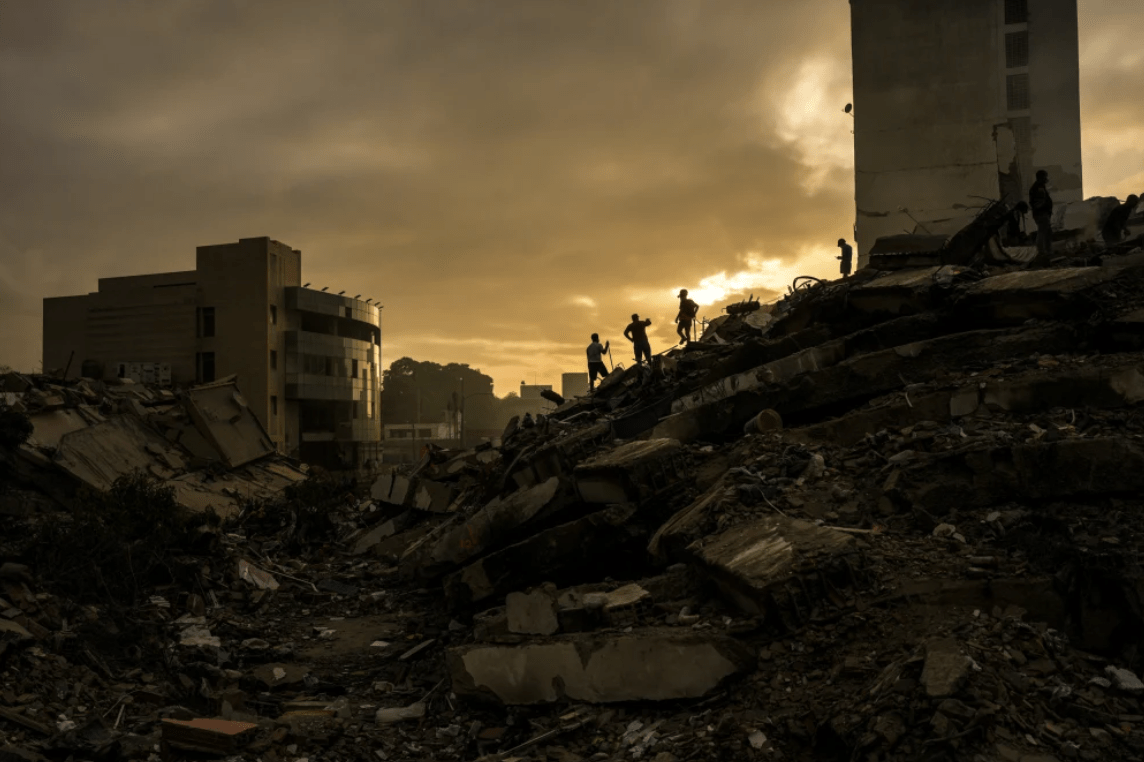
On June 24 Venezuela’s central coast was struck by two earthquakes of 7.2 and 7.5 magnitude on the Richter scale. So far, according to official figures, the consequences of these natural disasters include 2,595 deaths, 12,400 injuries, 12,841 people left homeless, 189 collapsed buildings, and 565 partially collapsed buildings. First and foremost, we must extend our solidarity and heartfelt condolences to the victims, as well as our gratitude to the individuals and institutions—both here and abroad—who have shown concrete solidarity in the face of the terrible consequences of the earthquakes.
Delcy Rodríguez’s de facto government has stated that it will “a national catastrophe should not be politicized.” However, although the causes of the two earthquakes are natural, the magnitude of their consequences is the result of government and corporate policies implemented before and after June 24. In technical terms, when dealing with extreme natural events, a distinction is made between exposure—the affected geographic area—and vulnerability—the propensity to be negatively affected and the lack of an adequate response capacity due to state, economic, and social factors. Residents and buildings along the country’s central coast, especially in La Guaira, were exposed to the two earthquakes due to their geographic location, but the magnitude of the impact depended on government and corporate policies that increased their vulnerability.
In this regard, it is necessary to demand and organize an Independent Truth and Justice Comission to address the consequences of the two earthquakes, in which trade unions, activist groups, NGOs, direct victims their family members, universities, and the general public participate, accompanied by technical experts in various areas.
I
In her address yesterday, Thursday, July 2, de facto President Delcy Rodríguez—without any investigation—already claimed that the collapse or structural damage to buildings constructed by the Great Housing Mission (Translator’s note: official housing program launched on 2011 by late president Hugo Chávez) or private companies occurred solely due to the so-called “doublet earthquake.” In this regard, the government has announced that its policy will be to guarantee total impunity for the former authorities of the Great Housing Mission and private construction companies.
Quite the contrary, it is necessary to launch and conduct an investigation with the primary objective of determining the potential liability of the former authorities of the Great Housing Mission, the construction companies, and municipal officials, which may ultimately find them guilty or exonerate them. In this way, it must be determined whether they complied with the legal standards and technical protocols regarding the conditions of the soil where these buildings were constructed and with the seismic safety regulations for such structures.
In this case, as in many others, we see the fallacy of highlighting an alleged fundamental antagonism between the state and private capital, between the state and the market, and between the state and private companies. In reality, we are witnessing how the cloak of impunity cast by the de facto government—as the embodiment of the state—seeks to shield both its high-ranking officials and the private construction companies. Therefore, regarding the consequences of the two earthquakes, we will only achieve truth and justice if an independent commission is established—one with technical expertise, but above all with the ability to exert pressure to compel state authorities to fully establish potential governmental and corporate responsibilities and, where applicable, to issue the necessary criminal and administrative convictions to achieve reparative and restorative justice.
II
In the same speech yesterday, Delcy Rodríguez said that after the two earthquakes there was a media campaign that centered the message “Everyone to La Guaira.” According to the de facto president, this was intended to hinder search and rescue operations. This is patently false, and is intended to defend the government’s handling of the aftermath of the two earthquakes and to attack the actions of activists seeking to help the direct victims. In reality, people went to La Guaira without coordination or planning, driven by the circumstances at the time—namely, the lack of legitimacy and trust in government authorities and their handling of the earthquakes’ aftermath, the weakening of social organizations and collective activism, and the absence of a legitimate opposition leadership to serve as a guiding voice.
The people who went to La Guaira—as well as those who have organized and mobilized throughout the rest of the country—observed the slow and inadequate response of the de facto government. Faced with mistrust of the state apparatus, they chose to take direct action in search-and-rescue efforts and to provide support by delivering donations of basic necessities such as water, medical supplies, food, sleeping mats, and clothing. This boils down to what we have heard on the streets: “However little I can donate, I’m not going to hand it over to them, so it won’t reach its destination—so it gets stolen.” This distrust of the de facto government on the part of the vast majority of the Venezuelan population is underlined by Delcy Rodríguez herself when she clarifies and emphasizes that the foreign funding to be received for the so-called reconstruction will be deposited into an account at the Andean Development Corporation (CAF), which will be subject to an international audit.
Furthermore, the uncoordinated and unplanned response from many people stemmed from the weakness, lack of visibility, and discrediting of nongovernmental organizations, social organizations, and activist movements, which have suffered repressive attacks by the government in recent years. This has forced them to withdraw from the public sphere, or to make concessions to state authorities; but also, in some cases, to their involvement in corruption related to the administration of so-called humanitarian aid, which began arriving in the country in 2019.
Finally, during a national emergency such as the aftermath of the two earthquakes, the people found themselves without legitimate leadership. María Corina Machado has been waiting for months for authorization from Donald Trump and Marco Rubio to return to Venezuela. This is because Machado’s political strategy following the July 2024 election has once again been to promote and await U.S. military intervention and economic sanctions. In practical, objective terms, Simón Bolívar’s phrase became all too clear: “To call oneself a leader without being one is the height of misery.” Thus, rather than serving the democratic struggle of the Venezuelan people, María Corina Machado has served the interests of the Trump administration in controlling the Venezuelan state’s geopolitical alignment and the extraction and export of our country’s oil. That is why, after the two earthquakes—far too late and merely in an attempt to reaffirm her political leadership—Machado presents through her communications apparatus an attempt to return to Venezuela, while in reality she is not doing anything to that effect. It would seem, then, that Machado prefers the continuation of Delcy Rodríguez’s de facto government to organizing and mobilizing the population to restore democratic freedoms and rights—and thereby undermining the stability sought by Donald Trump and Marco Rubio so they can continue plundering our country’s oil.
Ultimately, the establishment of an Independent Truth and Justice Commission in response would be a mechanism to uphold the concrete solidarity with the people in La Guaira and the rest of the country who have organized and mobilized to assist the direct victims of these extreme natural disasters. This concrete solidarity challenges in practice, on the one hand, the notion that material precariousness and state repression have completely severed the bonds of solidarity within Venezuelan society; and on the other hand, the notion that the neoliberal ideology of the dominant opposition leadership—which seeks to reduce and eliminate social rights and establish market purchases as the only means of meeting basic needs—has been fully imposed.
III
Delcy Rodríguez, at the same press conference, also highlighted the solidarity shown by foreign governments that have sent rescue workers, as well as the efforts of personnel from the Bolivarian National Armed Forces and other state agencies. She thanked Donald Trump and Marco Rubio for sending a military contingent to search for and rescue direct victims and for delivering humanitarian aid. She also extended her gratitude to leaders from Argentina, Brazil, Colombia, El Salvador, Spain, and Mexico, among others.
In this regard, it is undeniable that the resources and the rescue workers from those countries have, to a greater or lesser extent, succeeded in saving the lives of people trapped under rubble in La Guaira, for example. Therefore, we extend our direct gratitude to those women and men from different countries who came to our country to save lives through their work. Furthermore, our direct gratitude also goes to the Venezuelan women and men who, whether as civilians or state employees—such as firefighters or civil protection personnel—have dedicated their work and time to saving lives. However, in the case of foreign governments, it is important to note the use of public resources and rescue workers from those countries for political campaigns aimed at glorifying or whitewashing the image of state leaders. Furthermore, it is important to highlight the government’s attempt to defend the state’s military and police apparatus, despite its slow and lackluster response following the two earthquakes, because these forces are the internal pillar supporting the continuity of the de facto government.
For example, in the foreign context, the Trump administration has imposed economic sanctions and launched a military operation against the country, resulting in the confiscation of funds derived from the Venezuelan state’s oil exports. Donald Trump himself emphasized that, through its control of our country’s oil, his administration has recouped “many times over” the cost of the military operation on January 3, which involved the bombing of various areas of Caracas, Miranda, and La Guaira and the capture of former de facto President Nicolás Maduro. It is therefore implausible for the U.S. government to tout its supposed solidarity while it continues to confiscate the Venezuelan state’s oil resources.
Therefore, an Independent Truth and Justice Commission addressing the consequences of the earthquakes, together with the Venezuelan people as a whole, must demand the return of control over oil resources so they can be used to guarantee basic human rights for the direct victims, including health care, food, housing, education, and public services. Furthermore, an Independent Truth and Justice Commission, through its organization and mobilization, could demand that the state budget prioritizes the guarantee of basic human rights over military and police spending, extravagant expenditures, and the payment of the odious and illegitimate foreign debt.

